Congenital Stationary Night Blindness (CSNB): Complete vs Incomplete Type on ERG
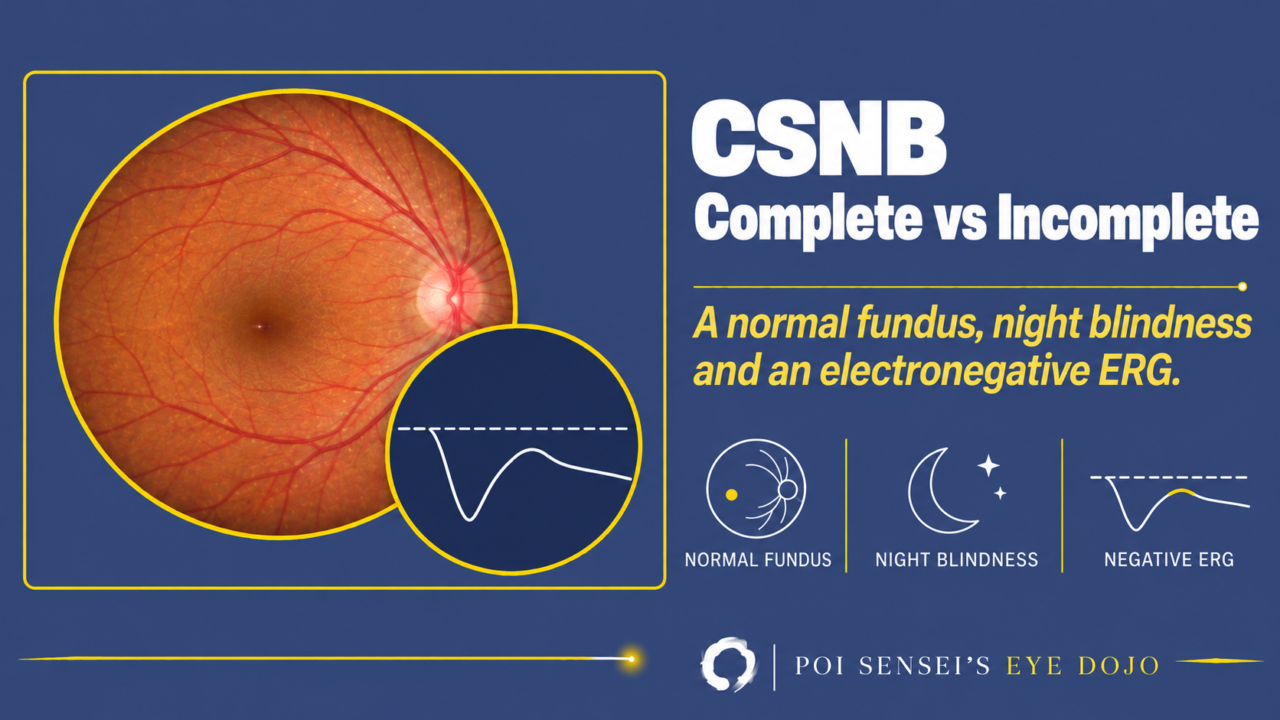
A child has night blindness, or poor vision that glasses do not fix, and the fundus looks normal. Think of congenital stationary night blindness (CSNB). The diagnosis rests on the electroretinogram (ERG). This article explains the two types, complete and incomplete, and how to tell them apart on the ERG.
- Night blindness has been there since early childhood and does not get worse.
- A child has reduced vision in both eyes that does not improve with glasses or amblyopia treatment.
- The fundus is normal, apart from myopic changes.
- The mixed response is electronegative (the b-wave is smaller than the a-wave).
What is CSNB?
In the broad sense, CSNB means any night blindness that does not progress. This includes Oguchi disease and fundus albipunctatus, which have an abnormal fundus. In the narrow sense, CSNB means stationary night blindness with a normal fundus. This article uses the narrow sense.
CSNB in the narrow sense mainly has two types: complete and incomplete. The cause is a problem with the bipolar cells.
Bipolar cells come in two kinds. ON bipolar cells respond when light comes on. They receive signals from both rods and cones. OFF bipolar cells respond when light goes off. They receive signals from cones only. So rods depend entirely on the ON pathway, while cones can use both.
CSNB can be X-linked, autosomal recessive or autosomal dominant. The X-linked forms are the most common. Many patients with X-linked or autosomal recessive CSNB also have nystagmus and myopia[1].
Complete CSNB
The ON bipolar cells do not work. Rods use only the ON pathway, so the rod signal cannot get through at all. Cones still send their signals through the OFF bipolar cells, so cone function is largely preserved.
Because the rod signal is blocked, night blindness is marked and is the main complaint. High myopia is common. The eye grows too long, and the failed ON pathway is thought to play a part in this[4]. The cones are preserved, so vision is often only mildly reduced[2].
The fundus is normal apart from myopic changes. Fluorescein angiography and OCT are also normal. There is no cure. We correct the refractive error.
Incomplete CSNB
Here the synapse between the photoreceptors and the bipolar cells is thought to fail. Both the ON and OFF pathways are affected. Signals through both are reduced, but not lost.
Night blindness is usually milder than in the complete type. Patients more often come in with reduced vision, around 20/100 to 20/25. High myopia is not typical, and the fundus is usually normal. There is no cure.
ERG findings
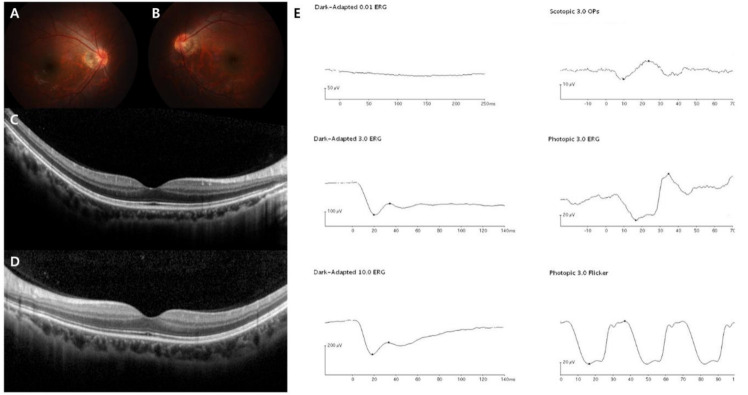
The ERG is the most important test for diagnosing CSNB. The a-wave comes from the photoreceptors, and the b-wave mainly from the bipolar cells. Both types usually show an electronegative mixed response. The rod and cone responses tell them apart.
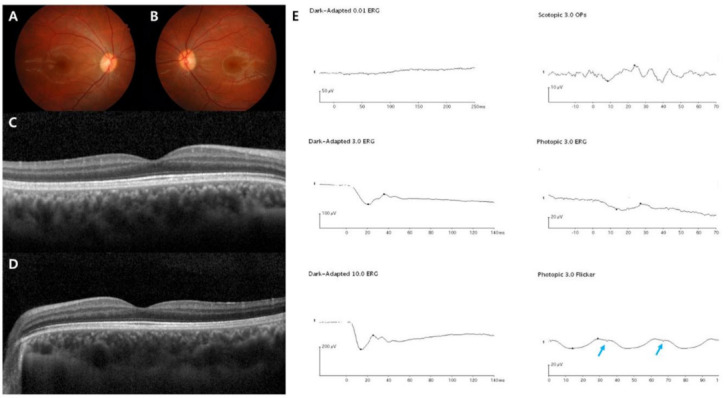
Compare these four responses. The mixed response (DA 3.0) is a bright flash in the dark, so rods and cones respond together. DA means dark-adapted and LA means light-adapted, and the number is the flash strength. The 30 Hz flicker is a fast-flashing light that only cones can follow.
| ERG step | Complete | Incomplete |
|---|---|---|
| Rod (DA 0.01) | Flat | Small but present |
| Mixed response (DA 3.0) | Negative | Negative |
| Cone (LA 3.0) | Near normal, wide a-wave | Reduced |
| 30 Hz flicker | Near normal | Reduced |
Complete CSNB
The rod response is flat. In the mixed response, the a-wave is normal but the b-wave is small, so the waveform is electronegative. The photoreceptors are working, but the ON bipolar cells do not pass the signal on.
The cone response is near normal in size, but the trough of its a-wave is wide and flat-bottomed (a "square" a-wave)[2].
Incomplete CSNB
Unlike the complete type, some rod response remains. The mixed response is usually electronegative too[3]. The cone response and the 30 Hz flicker are clearly reduced, because the OFF pathway is also affected.
Summary
- CSNB in the narrow sense is night blindness that does not progress, with a normal fundus. The cause is bipolar cell dysfunction.
- Complete CSNB: the ON bipolar cells fail. The rod response is flat and the cone response is near normal, with a wide a-wave. Night blindness is marked and high myopia is common.
- Incomplete CSNB: signals to both ON and OFF bipolar cells are reduced. Some rod response remains and the cone response is reduced. Patients come in with reduced vision.
- Both types usually show an electronegative mixed response.
- In a child with unexplained poor vision and a normal fundus, order an ERG.
Figure credits
Complete and incomplete CSNB: Figures 2 and 4 from Kim HM, Joo K, Han J, Woo SJ. Genes (Basel) 2021;12(6):789 (https://doi.org/10.3390/genes12060789), licensed under CC BY 4.0. Unchanged.
References
[1] Salmon JF. Kanski’s Clinical Ophthalmology: A Systematic Approach. 10th ed. Elsevier; 2025. Chapter 15, Inherited retinal degenerations: Congenital stationary night blindness.
[2] Yanoff M, Duker JS, eds. Ophthalmology. 5th ed. Elsevier; 2019. Chapter 6.14, Progressive and "stationary" inherited retinal degenerations.
[3] Kim HM, Joo K, Han J, Woo SJ. Clinical and genetic characteristics of Korean congenital stationary night blindness patients. Genes (Basel). 2021;12(6):789. PMID 34064005.
[4] Katta M, de Guimaraes TAC, Fujinami-Yokokawa Y, et al. Congenital stationary night blindness: structure, function and genotype-phenotype correlations in a cohort of 122 patients. Ophthalmol Retina. 2024;8(9):932-941. PMID 38522615.
Which retinal layer makes which wave, the three abnormal patterns, and the dark-adaptation trap to check before you report “negative” — on one page, by email. One email when I publish something new, about once a month. Unsubscribe anytime.