Intraoperative Floppy Iris Syndrome: Tamsulosin and Cataract Surgery
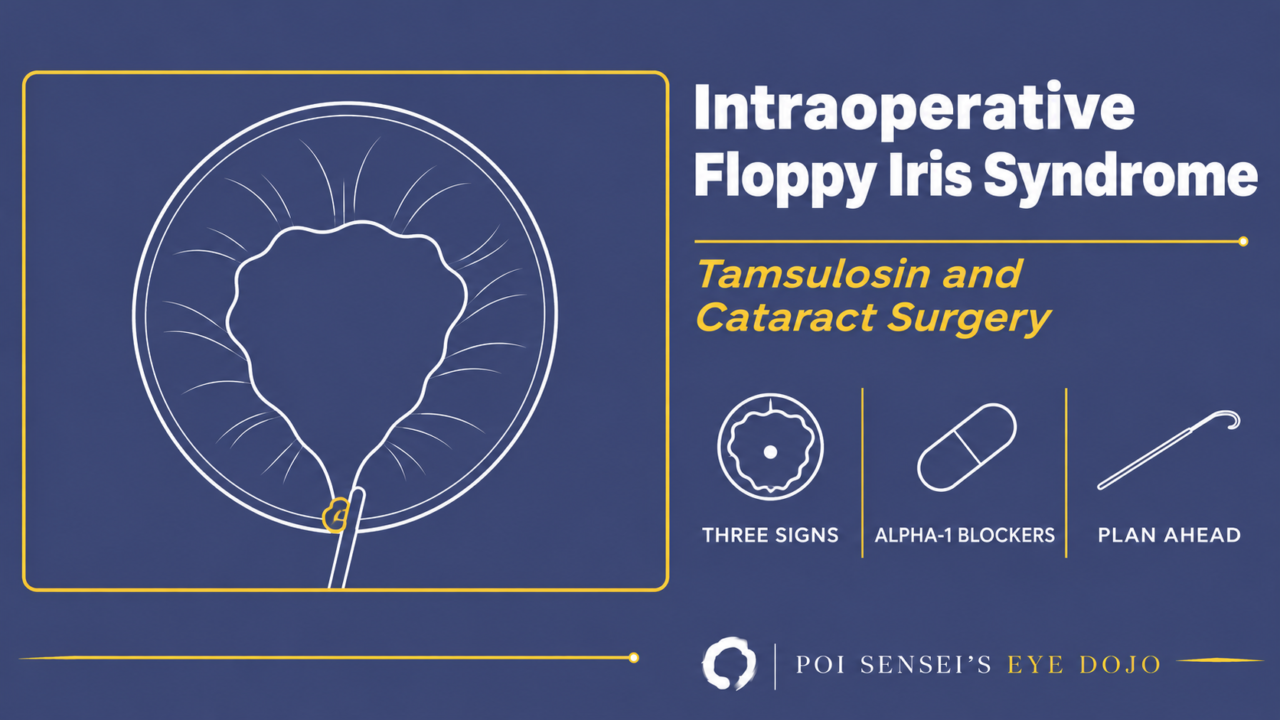
During cataract surgery in a patient taking an alpha-1 blocker such as tamsulosin, the iris can lose its tone and go floppy. This is intraoperative floppy iris syndrome (IFIS). It makes the surgery harder and raises the risk of complications, especially when it is not anticipated.
What happens during surgery
IFIS has three signs:
- Billowing of the iris with the irrigation flow
- Iris prolapse toward the main and side-port incisions
- Progressive miosis during surgery
These eyes also tend to dilate poorly before surgery.
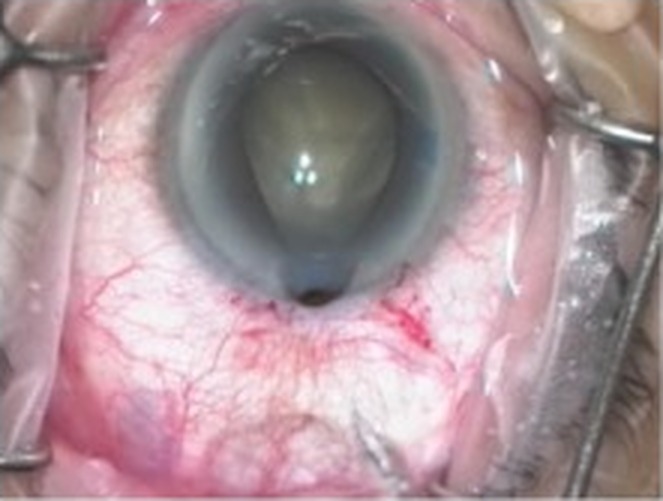
The iris has prolapsed through the main incision inferiorly and draws the pupil into a teardrop shape.
Why it happens
Like prostatic smooth muscle, the iris dilator works mainly through alpha-1A receptors. Alpha-1 blockers for the prostate are thought to block the same receptors in the dilator, so the iris loses its tone.
Which drugs to ask about
The main cause is an alpha-1 blocker for benign prostatic hyperplasia (BPH) or lower urinary tract symptoms:
- tamsulosin
- silodosin
- alfuzosin
- doxazosin
- terazosin
Tamsulosin carries a particularly high risk. In a 2022 network meta-analysis, the risk of IFIS with tamsulosin was about 14 times that in patients not taking these drugs[1].
Some drugs for other conditions also block alpha-1 receptors. The antipsychotics risperidone and paliperidone carry a warning about IFIS, and the herbal remedy saw palmetto has been linked to it too.
Stopping the drug does not prevent it
Stopping the alpha-1 blocker before surgery has not been shown to prevent IFIS, and IFIS has occurred in patients who had stopped it weeks or months before[2]. So these drugs are usually not stopped for cataract surgery.
What matters is knowing about the drug before surgery. Before every cataract operation, check the drug list, and ask:
"Have you ever taken a medicine for your prostate or for passing urine?"
Ask about past use too.
How surgeons plan for it
When IFIS is anticipated, it can be managed. Several steps are usually combined:
- Preoperative atropine, and intracameral phenylephrine or epinephrine, help maintain mydriasis.
- A viscoadaptive OVD such as Healon5, or a dispersive OVD, placed over the iris near the incision holds the iris back.
- Low aspiration flow and vacuum keep the OVD in the eye and the iris out of the phaco tip.
- Longer clear corneal tunnels make iris prolapse less likely.
- Iris hooks or a pupil expansion ring, kept ready in the operating room, hold the pupil open.
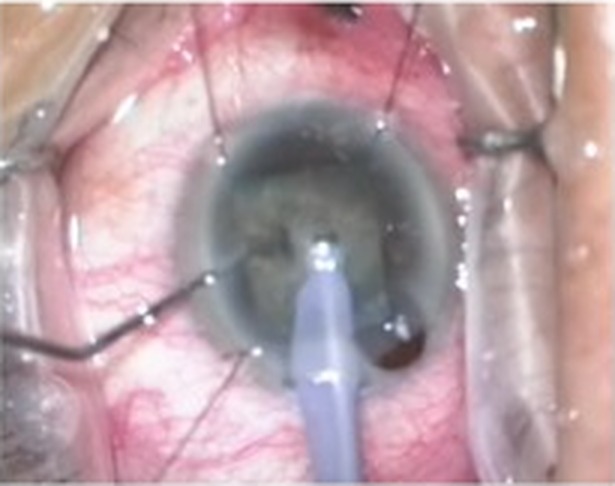
In this eye, the pupil kept constricting during surgery, so three iris hooks were placed at the pupillary margin to hold it open.
Summary
- IFIS is a floppy iris during cataract surgery, linked to current or past use of alpha-1 blockers such as tamsulosin.
- The three signs are iris billowing, prolapse toward the incisions and progressive miosis.
- Stopping the drug has not been shown to prevent it, so ask about current and past use before every cataract operation.
- When IFIS is anticipated, combine mydriatics, a viscoadaptive or dispersive OVD, low flow and vacuum, and pupil expansion devices.
References
[1] Wang YH, Huang LC, Tsai SHL, et al. Risk of intraoperative floppy iris syndrome among selective alpha-1 blockers—a consistency model of 6,488 cases. Front Med (Lausanne). 2022;9:941130. PMID 36111121.
[2] Tamsulosin hydrochloride capsules. Prescribing information, section 5.5. DailyMed, US National Library of Medicine. Revised September 2024. https://dailymed.nlm.nih.gov/dailymed/lookup.cfm?setid=fb120098-b007-4a33-80b8-b7279c7668ee



Which retinal layer makes which wave, the three abnormal patterns, and the dark-adaptation trap to check before you report “negative” — on one page, by email. One email when I publish something new, about once a month. Unsubscribe anytime.